
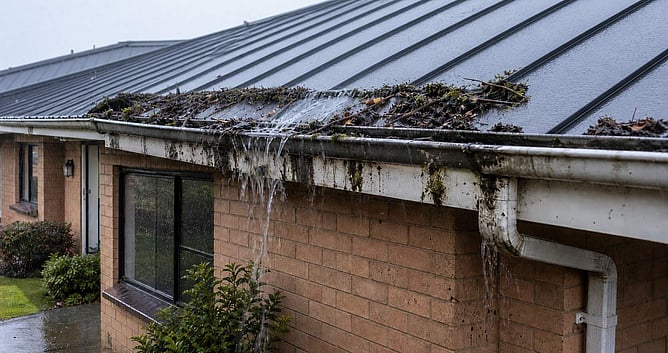
Most spouting problems do not begin in the spouting itself. They often start higher up on the roof, where water, debris, and roof condition all affect how runoff reaches the gutter line.
At Fine Line, we work on spouting, including continuous spouting, fascia, repairs, replacement, and installation across Hamilton and Waikato, so this roof-to-spouting connection matters every day.
When roof drainage is poor, the spouting system has to work harder than it should. Water can hit the gutter too fast, miss the intended flow path, or carry extra debris into the channel. Over time, that repeated stress can shorten the life of the whole system.
Roof runoff puts pressure on the gutter line
A roof is meant to collect rain and direct it neatly into the spouting. That sounds simple, but several things can interrupt the process. Loose fixings, worn flashings, blocked sections, roof debris, and uneven flow can all change how water behaves at the edge of the roof.
Once water stops moving cleanly, the spouting starts taking the impact. You may see overflow, staining, sagging sections, or repeated wetting in the same area. Even a good gutter system will struggle if the roof above it is not draining properly.
Debris from the roof creates avoidable wear
Roof drainage is not only about water volume. It is also about what the water carries with it. Grit, moss, leaf matter, and small roof debris can wash into the spouting and collect in low spots or corners.
That build-up slows the flow and keeps moisture sitting in the system for longer. Once that happens, overflows become more likely during heavy rain. The extra weight and trapped moisture can also increase wear on brackets, joins, and older sections of spouting.
This is especially relevant around Hamilton and the wider Waikato. Fine Line’s service area includes Hamilton, Rotokauri, and nearby towns, where a mix of mature planting, heavy rainfall, and older gutter systems can expose weak points more quickly. Our work on re-spouting and replacing leaking systems reflects how common those issues can be.
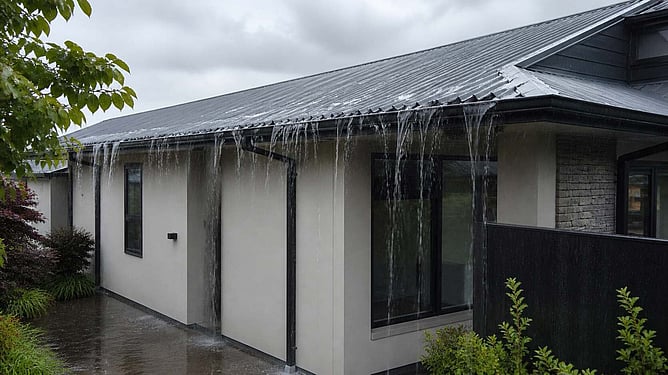
Overflow is not always a gutter-only problem
Homeowners often assume an overflow means the gutter itself has failed. Sometimes that is true. But sometimes the real issue is that the roof is sending water into the system in a way the spouting was never meant to handle.
For example, if flashings are not working properly, water may track into places it should not. If parts of the roof need repair, water can run unevenly and overload one section of guttering.
Paramount Plumbing’s Wellington roofing page makes this same point from the roofing side, covering repairs, flashings, spouting, downpipes, and maintenance as connected parts of the same water-control system.
That broader view matters. It helps explain why replacing one damaged gutter section does not always solve the problem for long. If the roof above still sheds water badly, the same area may fail again.
Wind and rain make roof-edge details more important
New Zealand homes deal with hard weather, but not every roof edge handles it the same way. Wellington for example, is known for strong winds and driving rain, and Paramount Plumbing highlights how that climate affects roofing, flashings, gutters, and downpipes.
While Hamilton is different, roof-edge details still matter whenever heavy weather tests the path rainwater takes off the home.
When water is pushed sideways, driven hard into corners, or dumped into one section during a downpour, weak points show up quickly. That is why spouting should be assessed as part of the wider drainage path, not as a stand-alone strip fixed to the fascia.
Fine Line’s focus on continuous spouting, conversions, and full replacement fits that practical approach
Signs the problem may start higher up
A few warning signs are worth paying attention to. Repeated overflow in the same spot is one. Water marks on fascia, staining below joins, and sections that seem to clog again soon after cleaning are other issues.
You might also notice that one side of the house wears faster than the rest. Paint may age sooner, timber may stay wet longer, or garden areas below the eaves may keep taking a pounding after rain. Those clues often suggest the roof drainage pattern needs a closer look.
In some cases, the next question is not about the gutter profile or colour. It is about the roof condition, flashing integrity, and how runoff is being delivered into the system. That is where a broader look at roofing becomes relevant, because roof repairs and drainage details often sit behind repeated spouting issues.
Final thoughts
Good spouting depends on good roof drainage. If water and debris are coming off the roof in large amounts, even a well-installed gutter system can wear out sooner than expected.
For homeowners in Hamilton and Waikato, the most useful approach is to treat the roof edge as a single working system. Roof condition, flashings, fascia, spouting, and downpipes all need to work together.
When they do, water moves away properly and the life of the spouting system is far more likely to match the investment. Talk to us at FineLine Fascia & Spouting for all your guttering needs.