
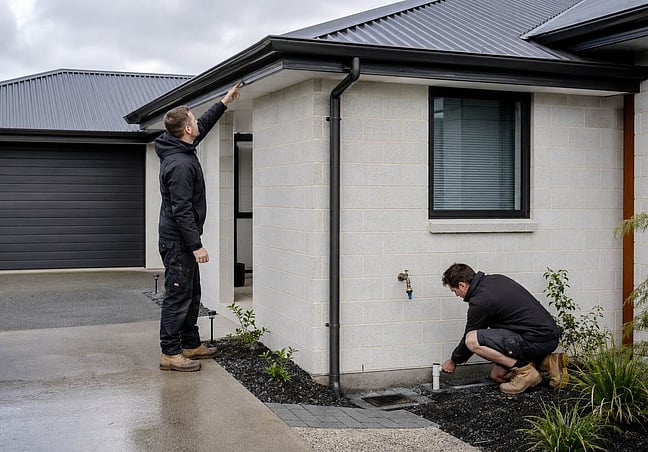
A lot of exterior water problems get labelled as gutter issues. Sometimes that is correct. Sometimes the real cause sits lower, wider, or further out on the property.
At Fine Line, we work on fascia, spouting, re-spouting, and internal gutter conversions for Hamilton and Waikato homes. We also work with homeowners and builders, so we often see where roofline issues stop and other exterior water problems begin.
Start with what spouting is meant to do
Your spouting has one main job. It catches roof water and sends it to the downpipes.
From there, the water should move away from the house in a controlled path. If that path breaks down early, the symptoms often show up fast.
Overflow at the front edge is a common sign. So are stained fascia boards, dripping joins, rust, or sagging sections. In those cases, the problem often starts at the roofline.
The roofline is only one part of the water system
This is where many homeowners get tripped up. Once water leaves the downpipe, the issue may move beyond spouting.
Ground levels, pipework, stormwater connections, hose taps, and water mains can all affect what happens next. That is why not every wet area outside the house is a gutter problem.
A downpipe can be working well while the ground below stays soaked. A gutter can also overflow because something lower in the system is not coping. Good diagnosis means following the full water path.
What sits under outdoor plumbing
Some exterior problems belong in a broader plumbing category. That can include leaking water mains, outside taps, exposed pipework, and other water services around the home.
That broader category is often called outdoor plumbing. Maxey Plumbing’s Wellington page on outdoor plumbing lists leaking water mains, hose tap replacement, and spouting clearing among its outside jobs, which shows how this term often sits wider than roofline work alone.
That distinction matters because the right fix depends on the source. Replacing spouting will not fix a leaking water main. A plumber will not solve a failing fascia profile by changing a hose tap.
Where homeowners often misread the problem
Most people spot the symptom first. They see a wet wall, water near the entry, pooling by the path, or muddy ground after rain.
Those signs can come from different causes. A blocked gutter, poor fall, damaged downpipe, broken underground line, or overflowing gully can all create similar results.
This is why surface clues can be misleading. The same puddle can come from the roof, the pipe below, or the ground layout around the house.
Signs the issue probably starts at the roofline
Look up first. If the spouting is rusting, bowing, leaking at joins, or spilling over, that is the best place to start.
Fascia staining is another clue. So is water jumping the gutter during short, sharp rain.
That matters in Hamilton and the wider Waikato. Fine Line’s local content points to sudden heavy downpours, humid summers, leafy suburbs, and rural properties as common conditions affecting gutter performance in this region.
Leaves and seed drop can also hide the real issue. A system may look fine from the ground while the outlet is packed with debris. On those homes, cleaning or repair may solve the problem before bigger work is needed.
Signs the issue may sit beyond the gutter
If the roofline looks sound, look lower. Water collecting near the base of the house can point to a different problem.
Soft ground that stays wet matters too. So do outdoor taps that leak, odd pressure changes, or water appearing far from the downpipe outlet.
These signs often suggest a plumbing or drainage issue outside the spouting itself. In that case, roofline work may still help, but it may not be the full answer.
Why this matters on Waikato homes
Waikato homes often deal with fast rain, plant debris, and mixed site conditions. Some homes sit on tighter urban sections. Others have larger yards, garden edging, or rural surroundings that change how water moves.
That means more than one trade can be relevant. A spouting specialist may identify the roofline issue. A plumber or drainlayer may need to look at what happens after the water leaves the house.
The key is not to guess too early. Start by tracing the path of the water from the roof to the ground. That simple step often saves time and repeat work.
A better way to think about exterior water issues
Ask one question first. Where is the water meant to go?
Then follow that route in order. Check the roof catchment, the gutter, the downpipe, and the discharge point.
If the breakdown happens at the top, it is usually a spouting problem. If it happens further out, the answer may sit with broader exterior plumbing. Once you separate those roles, the next step becomes much clearer.